
The PSD3 / PSR Political Agreement: What Was Decided, What Comes Next
Updated: Dec 26, 2025
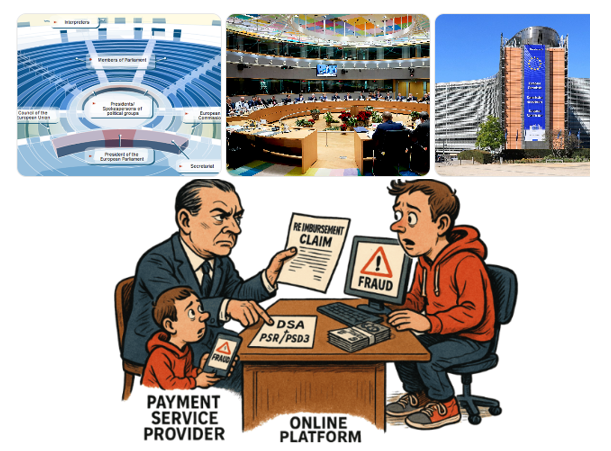
The Political Decision: Why This Agreement Matters
Following prolonged negotiations, the European Parliament and the Council of the European Union reached a political agreement on the new Payment Services Regulation (PSR) and the Third Payment Services Directive (PSD3) package on the basis of the proposal advanced by the European Commission.
This agreement is politically significant for three reasons:
It represents a strategic shift from minimum harmonisation to direct applicability, via the PSR.
It responds to systemic weaknesses in fraud prevention, especially Authorised Push Payment (APP) fraud.
It completes the post-PSD2 recalibration of EU payments law, aligning it with the Digital Finance Strategy, DORA, and broader consumer-protection objectives.
What Was Agreed: Core Elements of the PSD3 / PSR Package
A New Legal Architecture
The framework is split deliberately:
PSR (Regulation): directly applicable rules on conduct of business, transparency, fraud liability, and operational requirements.
PSD3 (Directive): institutional and prudential matters (licensing, supervision, passporting, governance).
This division aims to reduce national divergence that undermined PSD2’s effectiveness.
Stronger Fraud Protection & Liability Rules
A key political concession was enhanced consumer protection against fraud:
Mandatory reimbursement for certain APP fraud cases, subject to limited exceptions.
Reinforced obligations for PSPs on transaction monitoring and customer warnings.
Greater emphasis on shared liability across the payment chain.
This is one of the most contentious areas and will be heavily scrutinised in implementation.
Transparency and Fee Disclosure
The agreed text strengthens rules on:
Hidden charges and opaque FX mark-ups.
Pre-transaction and post-transaction disclosure obligations.
Comparability of fees across providers.
Open Banking / Open Finance Continuity
While not revolutionary, the package:
Consolidates access-to-account rules.
Seeks to stabilise business models for third-party providers (TPPs).
Addresses data-access friction without fully moving into “Open Finance” (reserved for future initiatives).
What Happens Next: The Formal and Practical Timeline
The political agreement must still pass through:
Legal-linguistic finalisation
Formal adoption by Parliament and Council
Publication in the Official Journal
Only then do the clocks start running. Indicatively:
PSR: applies directly after a transition period (18–24 months).
PSD3: Member States will have a transposition deadline (typically ~18 months).
For firms, the message is clear:
Compliance will no longer be defensive. It will be operational, technological, and strategic.
Early preparation, legal, compliance, IT, and governance-wise will be the decisive differentiator.
The agreed measures must be formally adopted by the European Parliament and the Council of the European Union before they can come into force. The Council and the Parliament will continue working on the technical elements of the package before final adoption by the co-legislators. We anticipate that the final texts will be published in the Official Journal of the European Union in H1 2026.