
Trust Is Important. But Is It Enough to Protect Your Business?

ENAH Business & Executive Insights
Trust is fundamental to every successful business. Owners trust their management teams to make the right decisions. CEOs rely on executives to run operations, on employees to do their jobs, and on partners to deliver.
Without trust, delegation stalls, decisions slow down and relationships suffer.
But trust alone does not tell you whether your business is operating as intended.
The real question is not whether you trust the people running your business. It is whether you can see clearly enough to know that it is running effectively, responsibly and the way you expect.
Trust and oversight are not opposites

Many owners see additional controls as bureaucracy, extra cost or a signal that they doubt their people.
Oversight is not distrust. Good internal controls support management. They give clear responsibilities, proper approvals, reliable information and a way to spot and fix problems early.
Take a growing company where purchasing, supplier relationships and payment approvals sit with a few experienced executives. They may be highly competent and entirely honest. But if their duties are not separated, transactions are not independently reviewed and management reports are incomplete, errors and irregularities can go unnoticed.
Imagine a supplier contract that keeps being invoiced at an old, higher rate for two years. The person who manages the supplier is also the person who approves the invoices, and no one compares the two. Or imagine a weakness that surfaces only when a bank, investor or buyer carries out due diligence, at the worst possible moment. (Illustrative scenarios.)
The issue is rarely integrity. It is whether the business has arrangements that work regardless of who sits in each seat.
Business growth changes the nature of control

Illustrative: when governance does not keep pace with growth, a gap opens.
In the early years, owners are involved in every important decision. They know their people, approve significant spending themselves and see operations first-hand.
As the business grows, that model stops working. New departments, management layers, subsidiaries, outsourced providers and locations add complexity. Decisions are made further from the owners, and information reaches them through several reporting lines.
At this stage, personal oversight needs the support of structured governance, clear responsibilities and reliable internal controls.
A business can grow considerably in size and turnover while its governance and controls stay where they were.
That gap creates vulnerabilities that often stay hidden until something significant goes wrong.
Owning a business from a distance
For owners who live abroad, the gap is wider. The same applies to owners who hold a business in Cyprus, Greece or elsewhere while based in another country. They cannot be on site every day, sit in on supplier meetings or sense that something is not right. They rely on reports, calls and the people on the ground, which means they rely on trust more than anyone.
That is exactly why they need independent, structured visibility: a clear view of what is actually happening, not only of what is being reported.
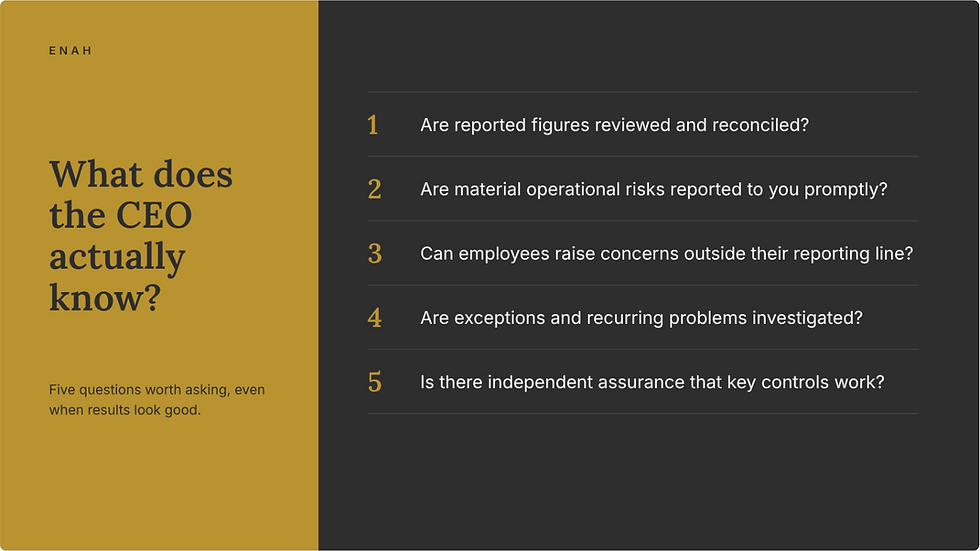
What does the CEO actually know?
Senior executives receive management reports, financial information, KPIs and updates from department heads. But having information is not the same as having complete and reliable information.
Five questions worth asking:
· Are reported figures reviewed and reconciled?
· Are material operational risks reported to you promptly?
· Can employees raise concerns outside their immediate reporting line?
· Are exceptions, control weaknesses and recurring problems investigated?
· Is there independent assurance that key controls work as intended?
These questions matter even when results are strong. Good financial results do not prove that controls are effective. The absence of reported incidents does not mean there are no weaknesses.
Internal audit: Beyond detecting problems

Many people think of internal audit as a function that looks for mistakes and non-compliance. Its value goes much further.
For larger companies this means internal audit. For smaller and owner-managed businesses it can be an independent review of governance and controls. Either way, it gives owners an objective view of how risks are managed and whether key procedures work in practice. It identifies weaknesses and recommends improvements before they become serious problems.
For owners, boards and CEOs who have delegated day-to-day operations, that independent view is particularly valuable.
It does not replace management's responsibilities, and it cannot remove business risk. It gives you better information to oversee the business and make decisions.
Building confidence through effective governance
Good governance should fit the company's size, complexity, business model and risk. It does not require thick policy manuals, extra management layers or complicated approvals.
What matters is that arrangements are appropriate, clearly understood and consistently applied. You should be able to answer four questions:
· Who is responsible for significant decisions?
· How are risks identified and reported?
· Do key controls work?
· How do concerns reach the right people?
Done well, governance gives management control without slowing the business down.
A question worth asking

For owners and CEOs, the choice is not between trusting people and implementing controls. You need both.
Trust supports relationships, delegation and effectiveness. Governance, internal controls and independent assurance provide the basis for oversight and accountability.
The question every business owner should ask:
"If something important were going wrong in my business today, would I know about it in time to act? And what gives me that confidence?"
The answer should rest on reliable information, effective controls and independent assurance, not on assumptions.
Because protecting a business starts with knowing what is really happening within it.
How ENAH can help
ENAH works with business owners, boards and CEOs, including owners based abroad, to give them an independent view of how their business really operates. Our Governance Health Check reviews governance arrangements, internal controls and reporting lines. We also provide internal audit support proportionate to the size of the business.
If the question above gave you pause, we would welcome a confidential conversation.
Contact us at consulting@enaservicesltd.com.
ENAH Services Ltd | Governance, Risk, Compliance & Internal Audit Advisory

